MAE 204 final project · MATLAB · Modern Robotics Toolbox · CoppeliaSim
Task and system
The project built a motion-control pipeline for a KUKA YouBot to execute a pick-and-place task in simulation. The robot had to move its mobile base and five-joint arm, approach a cube, close the gripper, transport the cube, and release it at a target pose.
MATLAB generated robot states, reference trajectories, and feedback commands with the Modern Robotics Toolbox. CSV output connected the controller results to CoppeliaSim for visual inspection of the task.
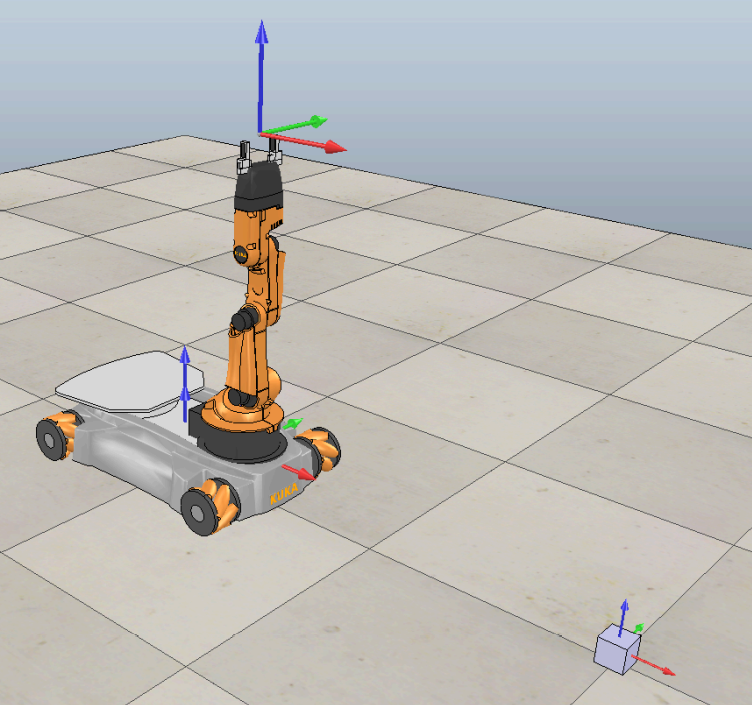
Controller pipeline
1. State propagation
The NextState function used first-order Euler integration to propagate the chassis,
arm-joint, and wheel states from commanded velocities over a fixed time step.
2. Reference trajectory
Trajectory_Generator produced a sequence of desired end-effector configurations for the task phases:
approach, descend, grasp, lift, transfer, descend, release, and retreat.
Separate gripper-state values synchronized grasp and release with the motion sequence.
3. Feedforward and feedback control
FeedbackControl combined a feedforward end-effector twist with proportional and integral feedback on the pose error.
The commanded end-effector motion was mapped to chassis-wheel and arm-joint speeds through the combined robot Jacobian.
A numerical pseudoinverse with a tolerance was used around poorly conditioned Jacobian configurations. The proportional and integral gains were varied to study convergence, overshoot, and oscillation across the tested scenarios.
Simulation experiments
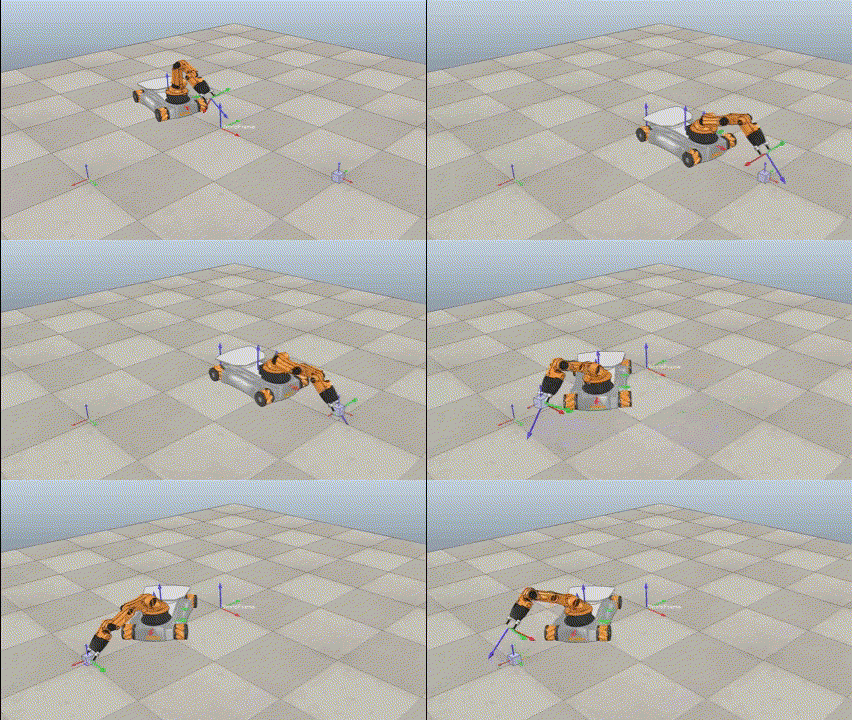
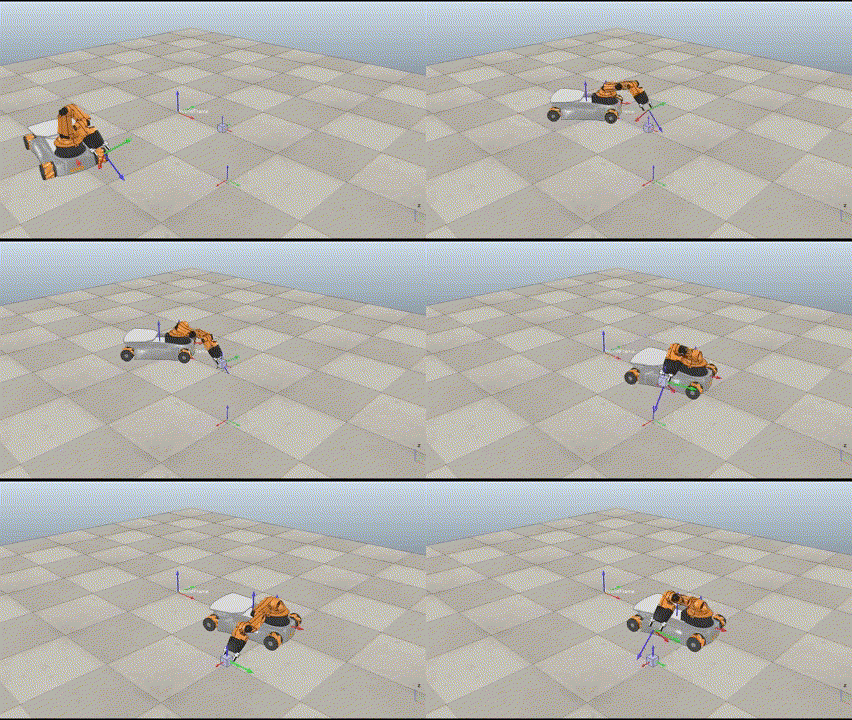
The documented test cases began with deliberate end-effector pose error relative to the first reference configuration. The plots and animations compare several gain choices and one changed task configuration.
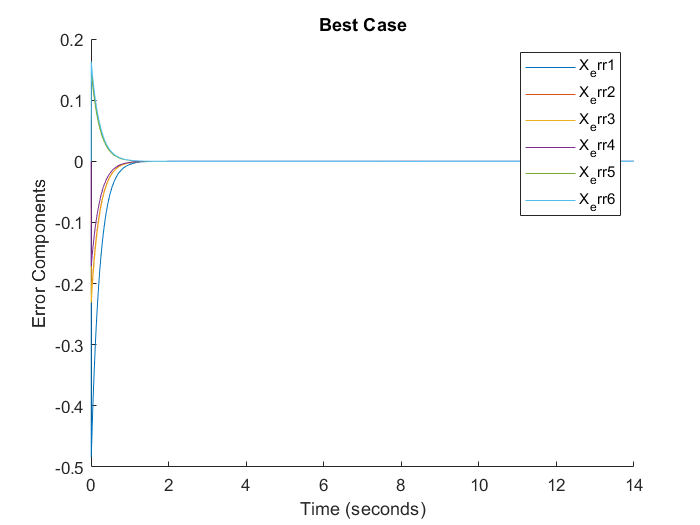
Balanced tracking response
One gain setting produced comparatively smooth trajectory tracking and rapid error reduction in the simulated task.
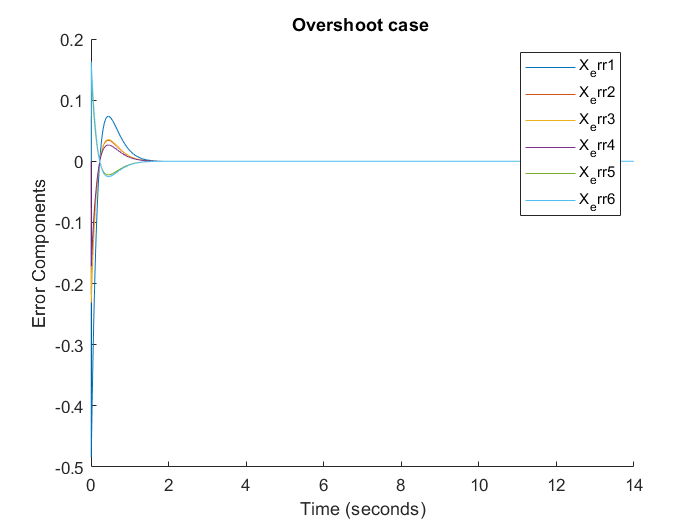
Overshoot response
A more aggressive response overshot before settling, making the effect of gain selection visible in the error trajectory.
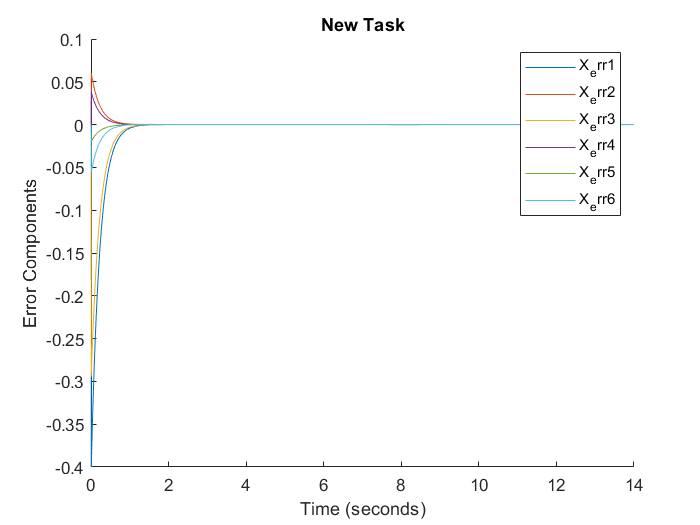
Changed task configuration
The same pipeline was also run with a changed cube goal that included a 90-degree orientation shift. This additional configuration is a limited scenario check and does not establish general-purpose adaptability.
Slow convergence and oscillation
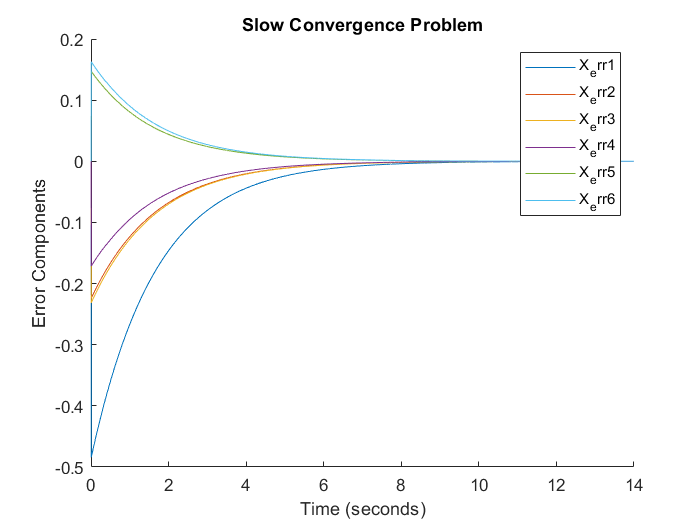
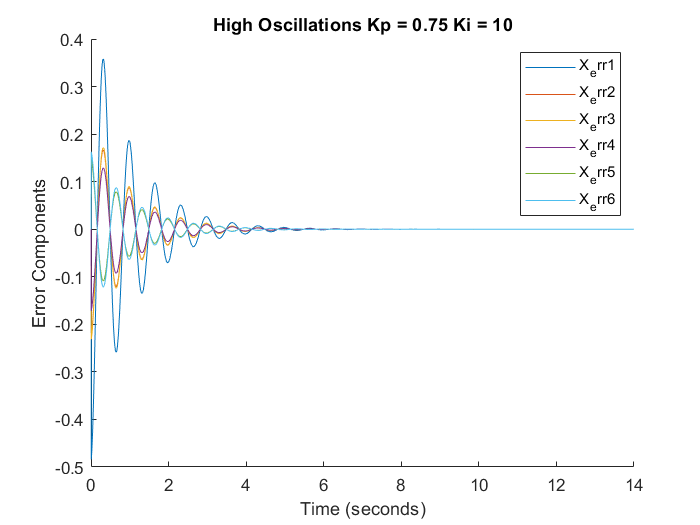
Lower feedback authority slowed convergence, while another gain choice produced sustained oscillation. Together, these cases expose the response-speed and stability trade-off in the selected PI structure.
What the project established
- A complete simulated pipeline connected state propagation, reference generation, feedback control, and task visualization.
- Gain sweeps made convergence, overshoot, and oscillatory behavior directly observable.
- A Jacobian pseudoinverse provided a practical way to compute actuator commands near poorly conditioned configurations.
- A changed target pose showed that task parameters could be modified without rewriting the controller pipeline.
Limitations and next steps
The experiments did not model sensing uncertainty, actuator latency, contact variation, or hardware safety constraints. A stronger next iteration would close the loop on measured robot state, add anti-windup and explicit singularity handling, define quantitative tracking metrics across a task suite, and validate the controller on hardware under conservative limits.