01 / Problem
Track a reference path with noisy motion.
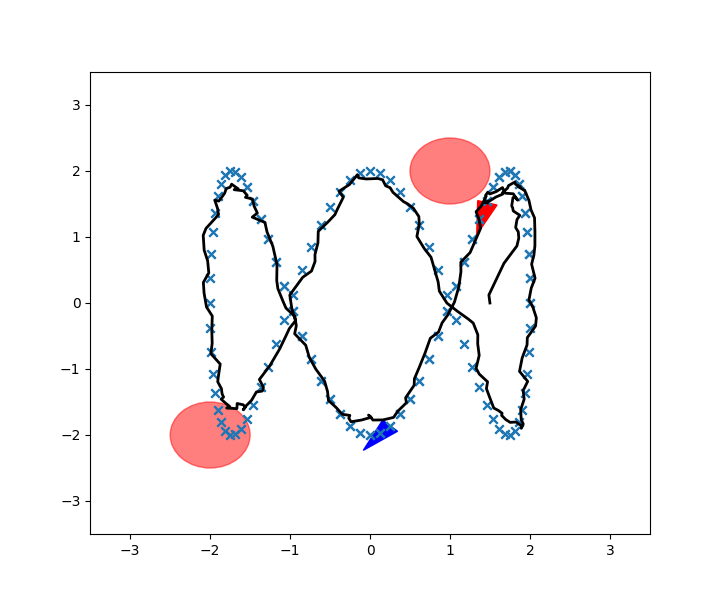
The differential-drive robot must trade position and heading error against control effort while respecting bounded linear and angular inputs. Gaussian motion noise makes the system state depart from its nominal trajectory.
02 / Receding horizon
Optimize a deterministic approximation at each step.
The certainty-equivalent controller sets process noise to zero inside a finite-horizon nonlinear program, solves that program with CasADi, applies the first control, and plans again from the updated state. Tuning balances tracking error, orientation alignment, effort, and obstacle penalties.
03 / Policy iteration
Explore the stochastic formulation directly.
I discretized error and control spaces and explored transition-probability, stage-cost, policy-evaluation, and policy-improvement computations. The formulation exposed a severe memory and computation scaling problem. The work did not establish a complete, benchmarked GPI controller, so this page does not claim smoother or better trajectories from it.
04 / Limitations and next steps
Computational scale, not theory, became the bottleneck.
- The receding-horizon solution was sensitive to objective weights and horizon choice.
- Its measured solve time was too slow for an online robot loop.
- Discretized GPI produced state-action tables too large for a practical full-resolution implementation.
A next iteration would first benchmark warm starts and solver settings for CEC, then test a compact function approximator for the value or policy instead of a dense GPI table.